Blogs
Formulating
R & D
Trends and Innovation
Biotechnology
Sustainability
Cosmetics Manufacturing
Innovation
Moving Bio-Based Ingredients From Concept to Cosmetic Reality.
Biotech is going to have a huge influence on the future of beauty but the hard work happens after the discovery. We look at the formulation constraints, commercial pressures, and scaling challenges that determine whether a breakthrough ingredient ever reaches a consumer. And why the UK, with the right partnerships in place, is well positioned to lead. Why Bio-Based Beauty Is the UK's Biggest Opportunity
May 11, 2026
Kristal Goodman, Head of Product Development, THG LABS

Blogs
Moving Bio-Based Ingredients From Concept to Cosmetic Reality.
Biotech is going to have a huge influence on the future of beauty but the hard work happens after the discovery. We look at the formulation constraints, commercial pressures, and scaling challenges that determine whether a breakthrough ingredient ever reaches a consumer. And why the UK, with the right partnerships in place, is well positioned to lead. Why Bio-Based Beauty Is the UK's Biggest Opportunity
May 11, 2026
6 mins read
Kristal Goodman, Head of Product Development, THG LABS
Innovation in the beauty industry is experiencing core change. The ingredients, the science, the supply chains, the very way we think about what goes into a product: all of it is being reimagined through the lens of biotechnology.
This month, some of the UK's leading voices in science, manufacturing, and policy are gathering at the BBIA's Bio-Beauty conference at SCI London to explore what that means for the industry and, crucially, what comes next. Our Head of Product Innovation, Kristal Goodman is among the speakers, and inspired by the conversation, we wanted to share our perspective as a full-service UK cosmetics manufacturer at the frontline of this movement.
The UK is better placed than it might think
When people talk about the global biotech revolution in beauty, the narrative often skips past the UK. It shouldn't.
The UK beauty market is already worth over £14 billion and continues to grow, significantly outpacing the wider economy. That growth is being powered by three converging forces: increasing demand for high-performance, clinically backed products; a clear trend towards premiumisation, with consumers buying fewer but better products; and a sustained shift towards ethical and sustainable formulations.
Layer on top of that the UK's genuine strength in engineering biology with a world-class network of research institutions and you have the foundations for genuine global leadership in bio-based beauty. The pieces are there. The challenge is connecting them.
Actives vs functionals: two very different conversations
One of the most important distinctions in formulation and one that's often overlooked in the broader biotech conversation, is the difference between innovative actives and functional ingredients. They behave differently in a formula, they carry different cost profiles, and they present different challenges and opportunities for bio-based alternatives.
Innovative actives: where biotech is already leading
The vast majority of new active ingredients coming to market right now are bio-based whether derived through fermentation, regenerative agriculture, or upcycling. Even traditionally synthetic molecules are increasingly being replaced with bio-based alternatives.
Actives sit at the highest cost point in a formulation. They're the ingredients that drive the brand story, support claims, and create perceived performance. But something important is happening science is gaining parity with storytelling. Consumers are becoming more educated. They want to understand how something works, not just be told a compelling narrative about where it came from.
That said, performance still leads everything. If an active doesn't deliver visible, tangible results (eg.better skin, improved texture, measurable change) the most elegant origin story won't sustain repeat purchase.
There's also a real communication challenge we need to address as an industry. Translating complex biotechnology into something a consumer can understand, be it through marketing, on-pack claims, or brand education, is genuinely difficult. Some consumers want the deep science. Others simply want to know: what will this actually do for me? We need to be able to answer both.
Functional ingredients: the quiet revolution
Functionals, the emollients, emulsifiers, and surfactants that make up the bulk of any formula, are a very different conversation, and in some ways a more consequential one.
These ingredients don't tell the product story. But they determine whether the product works. And because they make up a much larger proportion of the formula, they also have the biggest impact from a lifecycle and sustainability perspective.
Bio-based 'drop-in replacements' for petrochemical-derived functional materials are improving significantly both in performance and cost as well as availability. For a formulator, the ability to replace materials that have historically been petrochemical-derived is genuinely exciting, and we welcome every advancement in this area.
"Functionals don't tell the story but they make the story possible."
The honest challenge is cost. For premium brands, absorbing the price premium of bio-based functional alternatives is often manageable. For more price-sensitive products or for reformulating existing lines where cost is tightly controlled, matching both performance and cost becomes significantly more complex. This is where the industry needs continued investment in scale-up and manufacturing efficiency.
The barriers are real and worth being honest about
We believe in the future of bio-based beauty. But championing that future means being honest about the barriers because understanding them is the first step to removing them.
1) Cost and the premiumisation paradox
The growth in premium beauty is genuinely helpful for bio-based innovation, giving formulators more flexibility and brands room to absorb higher ingredient costs. But many of those same brands are simultaneously under pressure to value engineer, driven by rising costs across the supply chain. We're often working with two opposing forces at once: the desire to innovate and the need to control cost. Finding the sweet spot is what separates viable bio-based products from those that remain interesting but commercially unscalable.
2) Consumer expectations are rising and so is the pressure to deliver
Consumers are buying fewer products but expecting more from each one. Higher price points bring higher expectations in terms of efficacy, sensorial experience, and visible results. A bio-based product that underperforms its conventional equivalent won't survive regardless of how compelling the sustainability credentials are. Sustainability cannot come at the expense of performance. Consumers won't accept that trade-off, and they shouldn't have to.
3) Speed to market: the hidden challenge
As we all know, the cosmetics industry moves quickly. Typical lead times from formulation approval to product launch sit between 6 and 18 months. From our experience working closely with biotech start-ups, becoming truly 'cosmetic-ready' from a regulatory compliance, stability, scalability, and commercial perspective can take significantly longer than founders and investors anticipate.
In one of our own collaborations, it took close to two years from initial discussion to regulatory readiness. That's not a criticism of the science but rather a reflection of what it actually takes to bring a novel ingredient to market at scale. Brands need confidence that supply can meet launch timelines and it needs to be built through evidence, not aspiration.

"An ingredient isn't truly viable until it's scalable, stable, and aligned with commercial timelines."
Our partnership with Clean Food Group: innovation in practice
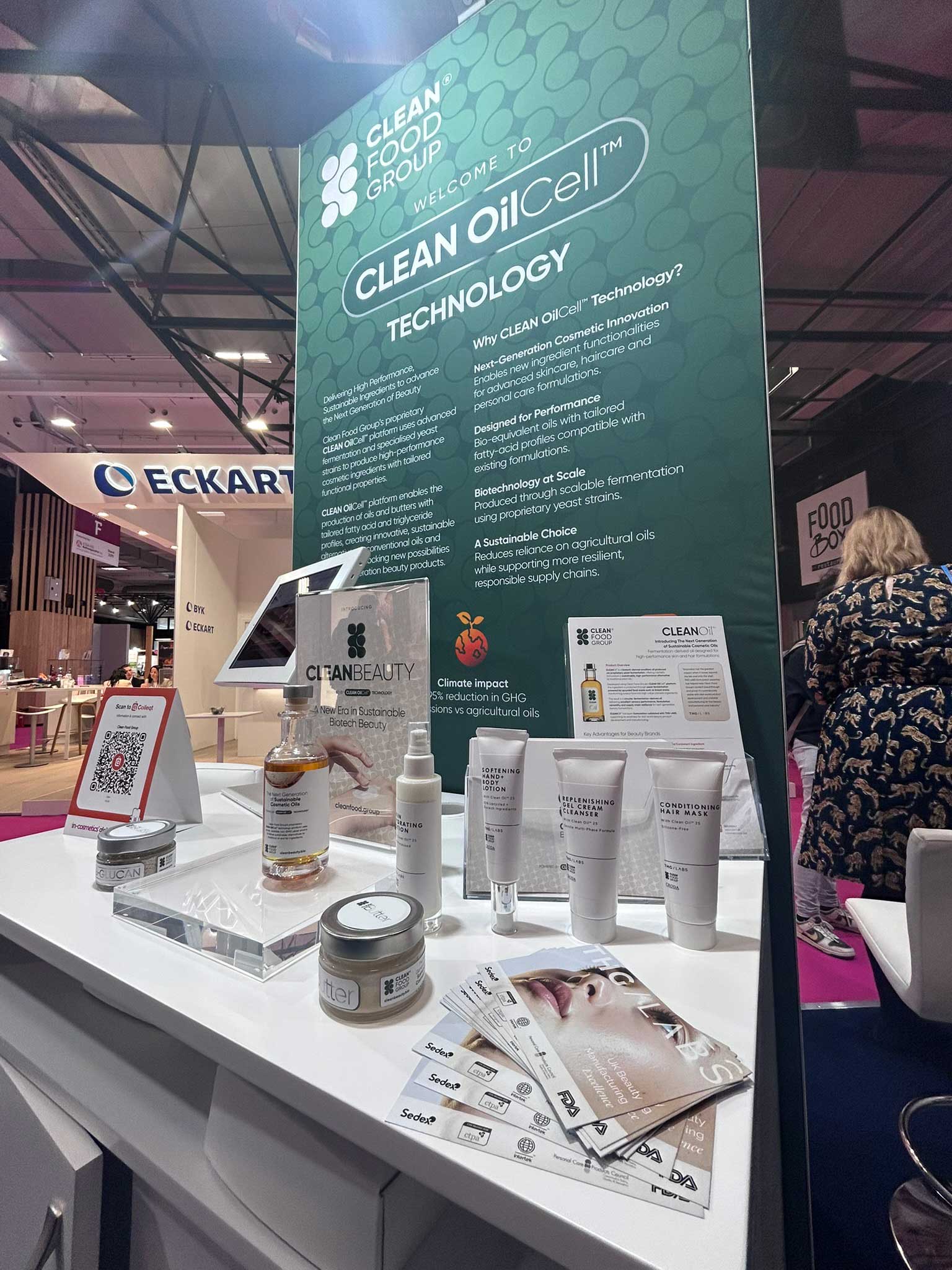
We talk about the importance of bridging the gap between biotech innovation and commercial formulation and through our partnership with Clean Food Group (CFG), we're doing exactly that.
CFG's CleanOil™ is a next-generation bio-based alternative to more agriculturally intensive oils. It represents a genuinely transformative step toward more secure and sustainable ingredient supply chains and with our product development specialism it’s moved beyond concept to become a real, formulation-ready ingredient.
Our collaboration brings together CFG's breakthrough technology and THG LABS' formulation and manufacturing expertise to help move responsibly sourced, high-performance ingredients from lab to shelf. We're proud that this partnership was highlighted in the 2026 Commit for Our Planet Second Initiative Report. It’s recognition that this kind of collaborative, evidence-based approach is exactly what the industry needs to make progress at scale.
It's also a reminder that sustainability leadership can’t exist in a bubble as a solo endeavour. It requires manufacturers, biotech innovators, brand partners, and regulators working in genuine alignment.
The opportunity ahead: alignment, translation, and scale
For us, the biggest opportunity to accelerate bio-based beauty in the UK comes down to three things:
- Better alignment between biotech innovation, formulation science, and commercial reality to ensure breakthrough ingredients don't stall between discovery and launch.
- Clearer consumer communication is essential. Leading with science and efficacy while translating that into benefits people can actually understand and connect with.
- Finally, a shared commitment to scale. An ingredient that works beautifully in a lab at 100g but can't be produced reliably at commercial volume isn't yet a product.
The BBIA's Bio-Beauty conference is an important moment for this conversation. Of course all these challenges can’t be solved in a single day but it demonstrates the industry is increasingly ready to have an honest, grounded, forward-looking discussion about what it actually takes to make bio-based beauty work… for brands, for consumers, for supply chains, and for the planet.
For us at THG LABS, "Formulation is where innovation meets reality."
…and we couldn't be more excited about what's coming.
To learn more about our sustainability commitments and our partnership with Clean Food Group, visit thglabs.com/sustainability

ABOUT THE AUTHOR
Kristal Goodman
Head of Product Innovation, THG LABS
With over 25 years’ experience in the beauty industry and UK cosmetics manufacturing, Kristal Goodman has cultivated a unique blend of scientific expertise, creative vision, and strategic thinking to spearhead what are recognised as some of the beauty industry’s most much-loved, must-have products.
In her role as the Head of Product Innovation, Kristal’s influence is best demonstrated in THG LABS dedication to pushing boundaries. She is the driving force behind the integration of upcycled ingredients, advanced biotechnology and other impactful emergent global beauty trends that ensure THG LABS remains at the cutting-edge of beauty innovation. Her knowledge of actives and their benefits is encyclopaedic which fuels her talent for translating ingredient ideas and science into concepts that give each product a formula and a story consumers fall in love with.
A member of THG LABS Eco Leadership Team and a devoted advocate for formulating sustainably, Kristal adopts a holistic approach to product development, believing that truly innovative beauty products are those that address the multifaceted needs of today’s consumers while better respecting the world around us.